RSA 25 Salisbury
25-26th April 2025
AGENDA & REPORTS FOR THE AGM CAN BE FOUND ON THE COMMITTEE DOCUMENT PAGE
A report on the gala weekend events
by
Richard Wright
RSA 25 –
and the dragon who came to dinner
Well, I hope that was a ‘read-on’ headline for you? I was going to call the report “…and the cathedral that moved” but that felt a bit tame by comparison. So please read on to see what I’m talking about whilst I recount the weekend:
RSA 25, our AGM Meeting and Social Weekend was based in the very agreeable surroundings of the Milford Hall Hotel, in the centre of the historic city of Salisbury – a venue found for us by our event organisers Paul Clayton and Chris Whichello. What a great place to stay, so a big thank-you to Paul and Chris.
Our weekend began with the AGM on Friday afternoon, and it appeared that several attendees - including me - had had ‘challenging’ journeys with cancelled trains or blocked roads. Happily, I’d arrived just in time to join some other RSA friends in the bar before the meeting (surely not? Ed).
I’m sure that there will be a full AGM report elsewhere in this issue, but my understanding is this:
This year’s AGM was particularly important for the RSA for three reasons: we’ve lost several branches over the last few years because they couldn’t get volunteers to fill the required official roles for the branch so they had to suspend operations. Secondly, because we need – after many years – to resolve the conflict between members who pay (or don’t pay) to belong to the RSA. Lastly – and perhaps more controversially – to complete the move towards on-line communications with RSA members. All these topics have been debated at length at Central Committee level, all branches have been consulted and many hundreds of individual members have been invited to comment.
RSA chair Andy Maynard explained that: (1) simplifying branch constitutions would make it easier for groups of RSA members to organise local events with fewer branch officers: (2) that it was now some 15 years since RSA was obliged to introduce subscriptions following the withdrawal of CAA and NATS funding and that it was no longer appropriate for non-paying members to enjoy the same benefits as their paying colleagues and: (3) that communications - including ‘Contrail’ – would transfer to digital-only over the next 18 months. Andy explained that there would be on-going safeguards for RSA members without on-line access. All the AGM motions were ‘carried’ by members (mostly unanimously, with a couple of abstentions and (as I recall) only one vote against.
So, where does that leave us? We live in changing times, don’t we? When RSA was established more than 40 years ago, most retirees wanted to remain in contact with their former work-mates, but now they have more independent social arrangements and are – perhaps - less interested in former colleagues. Like it or not, that’s the way it is and the RSA needs to evolve to remain relevant. The changes introduced at the AGM will help that aim.
At the AGM, Colin Chisholm, our long-standing Pensions Rep (and former Trustee) retired from the Central Committee. Chairman Andy thanked him for his service and he was warmly applauded. I know that when an MP retires they usually say that they’ll be “spending more time with their family.” I have this little nagging thought that Colin might just be spending more time with his golf clubs…. Anyway, I’ve been appointed to succeed Colin as your Pensions Rep and I have to tell you that he’s left some pretty big shoes to fill! I’ll do my best!
In the evening, we settled down to drinks followed by an excellent buffet supper and there was a steady hum of conversation as members caught up with one another. Later during our meal, some of us were introduced to what must be one of the most unusual guests in RSA history – a very large lizard called Falkor, who happens to be the pet of the hotel’s receptionist Sophie. “She’s actually a bearded dragon,” her owner told me, “and she’s a real attention queen. She loves it when my daughters take her to the shops and she gets petted by the children.” Well, Falkor seemed to appreciate the RSA members she met over dinner and I hope that she returned home happily. Does meeting a dragon beat moving a cathedral? That’s another read-on!
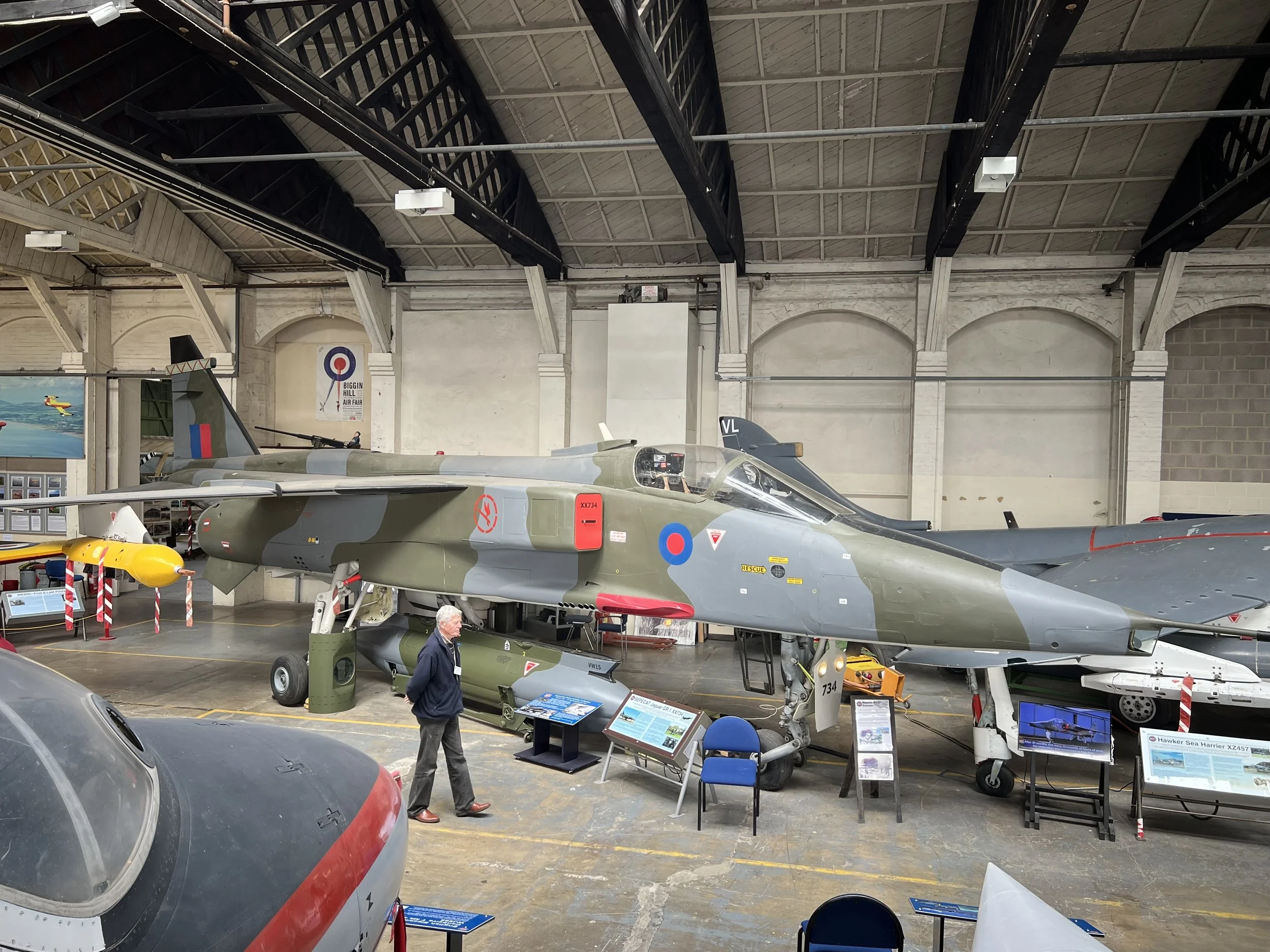
On Saturday morning we divided into groups: some members enjoying Salisbury in their own way; others went on a guided walking tour of the city, and I joined the coach for a short journey to tour the Boscombe Down Aviation Collection, which is based at Old Sarum Airfield.
RSA member Phil Holt (thank-you Phil) explained that Old Sarum is the oldest military airfield in the world, having been a base for the Royal Balloon Corps before being repurposed for the Royal Flying Corps during the First World War. Nowadays, there are some private aircraft based there, and a parachute-jumping club, but the airfield is probably better known for being the home of several ‘Belfast’ aircraft hangars, all of which are listed Grade 2* (meaning they’re very very rare and important).
Tech-y bit – but you can skip this – Belfast hangars get their name from an ingenious set of criss-cross wooden trusses that support a wide roof-span without requiring intermediate floor supports – thus providing a completely unobstructed space within the hangar walls. The company that made them (and patented the design) was based in…. Belfast. OK? Now back to the story.
The Boscombe Down Aviation Collection occupies two of the ‘Belfast’ hangars and is focused on aircraft and equipment that had – at some point - been used at Boscombe Down Airfield, home (for many years) of the Aircraft Evaluation Unit and the Empire Test Pilots’ School. Unlike most museums (which they insist it isn’t), BDAC operate a ‘hands-on’ policy so that you can climb into aircraft cockpits and touch exhibits. Besides our RSA members reflecting on past adventures I’m happy to report there were many parents visiting with young children who were – in some instances – screaming with pleasure at pulling heavy levers to make things move. If you’re ever worried about your grandchildren spending too much time on their phones, bring them here: they’ll have a great day out – and so will you.
As we left Old Sarum, we passed the huge Iron-age hill-fort that gives the area its name. Back in the day there had been a castle and a cathedral within the defensive rings of the fort. As it happens, I’m a sucker for place names and I noticed a road-sign for the hamlet of “Stratford-sub-Castle” nestled just behind the fort. Doesn’t that just tell you everything you want to know? Very satisfying for us nerds!
Back in Salisbury I caught up with some of the guided walkers, who introduced me to the network of medieval streets around the market-place in the old town. Some of the streets still bear the names of their original functions: Ox Row, Salt Lane, Oatmeal Lane, Hog Lane and The Poultry Cross, all used as trading places. It doesn’t take too much thought to understand, does it?
But I wondered about how and why the Salisbury (New Sarum if we’re being picky..) we know today had originated, and what had happened to the castle and cathedral on the hilltop at Old Sarum. After all, a cathedral barely 200 years old is still almost ‘one owner from new’ in church terms. This is what I discovered:
The hill-top fort at Old Sarum was easily defensible and the Saxons beat off attacks from the Britons and then the Danes. It’s mentioned in the ‘Anglo-Saxon Chronicle’ (an important book but not anywhere in Amazon’s best-seller list by-the-way) and became an important town as a result. A Norman bishop (Saint Osmund) built a castle and cathedral, but then he fell out with King Stephen – who promptly confiscated the castle. For the next 200 years the monks argued with the castellians (is that a word? Ed) about the amount of water they could draw off to make the mead which they needed to sell to fund their religious activities. And they didn’t like the constant hilltop winds, either. (This isn’t going to end well. Ed)
Eventually, in the 1200s the Bishop and his monks agreed they had to move and (legend has it) employed an archer to fire an arrow into the distance, and they would build a new cathedral wherever the arrow fell. The arrow lodged in the flank of a deer that ran a couple of miles before collapsing on the flat meadows beside the river. The Pope of the day (Honorius 3rd, should you ask…) wrote in 1219 ‘Let us descend joyfully to the plains, where the valley abounds in corn and there is freedom from persecution’.
And there, dear reader, is where Salisbury Cathedral stands today.
I went to the cathedral and, unlike most British cathedrals, Salisbury was built in a single style (Early English Gothic – but I guess you know that) so it has a wonderful sense of cohesion. Work started in 1220 and was largely completed by 1270, with the amazing spire (Europe’s tallest medieval structure at 404 feet) completed 50 years later. If you want to get a sense of how daring/challenging that building was, I recommend William Golding’s ‘The Spire’. I’ve read it so often that my copy is falling to bits.
And then in the cathedral cloisters, there are two video-loops: one is of the climbers who ascend the spire (inside) and then open a hatch near the summit, to ascend outside to climb the remaining 50 or so feet to keep the hazard lights functioning. If you don’t like heights then DO NOT watch this video. The second feed is from the nest of a family of peregrine falcons nesting on a ledge at the top of the tower. How good is that? Well worth a look.
But one of the things that impresses me about Salisbury Cathedral is its efforts to remain relevant to today’s congregation (and I don’t mean ‘woke’, whatever that is): Salisbury was the first Cathedral to employ a girls’ choir (in 1991) alongside the traditional boy choristers, and the church furnishings include a superb water-fountain font in the nave, and a modern altar with contemporary stained glass referencing modern martyrs.
I walked back to our hotel visiting the church of St Thomas & St Edmund, which was built as a place of worship for the craftsmen who were building the new cathedral. Its wonderful ‘Doom’ painting was surely a source of inspiration (or fear) for the medieval stonemasons, and for the centuries of visitors who follow.
So, whilst Salisbury is very much a ‘church-inspired’ and influenced town, it has developed so many links that today, it is an important regional trading town – and a great place to visit.
In the evening we assembled for drinks before our Gala Dinner. I’ve been to many of these functions before and I’d like to report that the Milford Hall staff were absolutely the best I’ve come across over the years. Thank you – and thanks also to Paul and Chris for guiding us to such a great weekend.
I returned home on the Sunday, although I know that some of our members stayed on. What did I take away from our RSA 25 weekend?
RSA is entering a new - streamlined – phase. We’re here for all of you, but you need to recognise that it costs us to look after you, whether you attend our events or not. Working with the people who pay your pensions is our business. Think about it!